
Strength and durability are two of the most important characteristics of industrial metal components. Products used in automotive systems, construction machinery, agricultural equipment, mining operations, and heavy industrial applications must withstand mechanical loads, vibration, friction, and changing environmental conditions. Iron castings are widely used in these sectors because they offer a combination of structural strength, wear resistance, and manufacturing flexibility. However, achieving consistent performance requires more than simply melting iron and pouring it into a mold.
An experienced Iron Castings Manufacturer follows carefully controlled production procedures to develop components that meet specific mechanical and dimensional requirements. Material selection, chemical composition, mold design, cooling conditions, machining, and quality inspection all influence the final product. Understanding how manufacturers manage these factors provides useful insight into the production of strong and durable iron cast components.
Understanding Strength and Durability in Iron Castings
Strength refers to a material’s ability to withstand applied forces without breaking or experiencing permanent deformation. Durability describes how well a component maintains its functionality over an extended period under actual operating conditions.
Both characteristics are important in industrial manufacturing, but they are not exactly the same. A casting may have high tensile strength but still experience premature wear if it operates in an abrasive environment.
Several material properties influence the performance of iron castings:
- Tensile strength: The ability to resist forces that pull or stretch a component.
- Compressive strength: The ability to withstand forces that push or compress the material.
- Hardness: Resistance to indentation, scratching, and surface deformation.
- Toughness: The ability to absorb energy and resist fracture under impact.
- Fatigue resistance: The ability to withstand repeated loading cycles.
- Wear resistance: The ability to resist material loss caused by friction and abrasion.
Manufacturers consider these properties when determining the appropriate material grade and production method for each component.
1. Selecting the Right Cast Iron Material
Material selection is one of the first steps in producing strong and durable iron castings. Different grades of cast iron have different graphite structures and mechanical characteristics, making them suitable for specific applications.
Gray Cast Iron
<AsyncImage query=”gray cast iron industrial machine component engine block casting” aspectRatio=”16:9″ width=”100%”/>
Gray cast iron contains graphite flakes distributed throughout its metal structure. It offers good compressive strength, machinability, thermal conductivity, and vibration-damping properties.
These characteristics make it suitable for engine blocks, machine bases, brake components, and industrial equipment housings.
Ductile Cast Iron
<AsyncImage query=”ductile iron cast metal industrial mechanical component close up” aspectRatio=”16:9″ width=”100%”/>
Ductile iron contains graphite in spherical shapes, which improves its tensile strength, toughness, and ductility compared with conventional gray iron.
It is commonly used for crankshafts, gears, pipes, automotive components, and heavy machinery parts that experience substantial mechanical loading.
White Cast Iron
White cast iron contains a hard structure with significant carbide content. Its high hardness provides excellent resistance to abrasion and surface wear.
It is frequently used in crusher components, grinding equipment, mill liners, and other industrial applications involving abrasive materials.
Alloy Cast Iron
Alloy cast iron contains additional elements such as nickel, chromium, or molybdenum to modify specific material properties.
Depending on its composition, it may offer improved wear resistance, corrosion resistance, or performance at elevated temperatures.
Selecting an appropriate material helps ensure that the finished component can withstand its intended operating conditions.
2. Controlling Chemical Composition
The chemical composition of cast iron has a direct influence on its microstructure and mechanical properties. Manufacturers carefully control the amounts of carbon, silicon, manganese, sulfur, phosphorus, and other alloying elements.
Carbon is particularly important because it influences graphite formation and carbide development. Silicon promotes graphitization, while other elements can affect hardness, strength, and solidification behavior.
For specialized grades, manufacturers may introduce alloying elements or apply specific metal treatments to achieve the desired characteristics.
Chemical analysis is commonly performed using spectrometers and other testing equipment. These checks help verify that molten iron meets the composition requirements before it is poured into molds.
Consistent chemical control reduces variations between production batches and supports predictable material performance.
3. Optimizing Mold Design and Casting Geometry
<AsyncImage query=”industrial foundry sand casting mold iron casting production preparation” aspectRatio=”16:9″ width=”100%”/>
Mold design is another important factor influencing the strength and durability of iron castings. Poorly designed molds can cause uneven metal flow, incomplete filling, internal cavities, and other defects that weaken the finished component.
Manufacturers consider several design elements when preparing molds.
Wall Thickness
Consistent wall thickness helps promote more uniform cooling and solidification. Sudden changes in thickness may create different cooling rates and increase the possibility of shrinkage-related problems.
Gating System
The gating system controls how molten iron enters the mold cavity. Proper design helps reduce turbulence and limits the risk of gas entrapment and other flow-related defects.
Riser Placement
Risers supply additional molten metal during solidification to compensate for shrinkage. Their placement and size must be carefully considered according to the component’s geometry.
Pattern Accuracy
Accurate patterns help ensure that the final casting matches the required dimensions. Shrinkage and machining allowances must also be included during pattern development.
Well-planned mold design supports structural consistency and reduces the likelihood of defects that could affect component performance.
4. Maintaining Proper Melting and Pouring Temperatures
<AsyncImage query=”molten iron pouring from foundry ladle into industrial sand casting mold” aspectRatio=”16:9″ width=”100%”/>
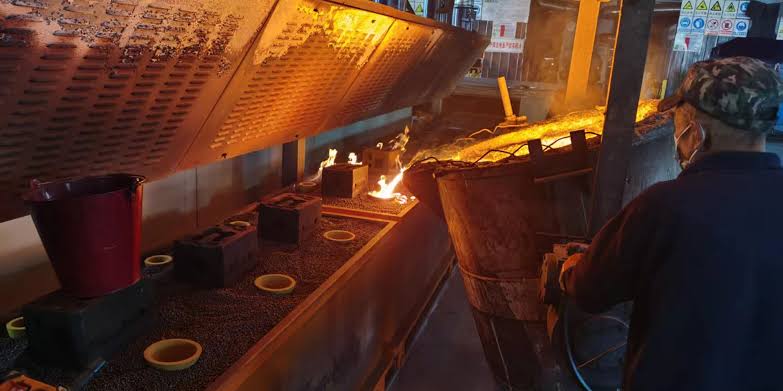
Temperature management plays an essential role in producing reliable iron castings. Molten iron must have sufficient fluidity to fill the mold while maintaining suitable conditions for solidification.
If the pouring temperature is too low, the metal may not completely fill the mold. Excessively high temperatures can increase oxidation, mold reactions, and other production risks.
Manufacturers monitor furnace temperatures and pouring conditions using suitable measuring instruments.
The pouring process must also be controlled to avoid excessive turbulence and unnecessary air entrapment. Consistent pouring practices help produce castings with fewer defects and more predictable mechanical properties.
5. Managing Cooling and Solidification
After molten iron enters the mold, it gradually cools and solidifies into the required component shape. The cooling process influences the final microstructure, hardness, strength, and internal stress distribution.
Different casting sections may cool at different rates depending on their thickness, mold material, and surrounding conditions.
Manufacturers consider these differences when designing the mold and selecting appropriate production parameters.
Controlled cooling helps reduce problems such as:
- Internal shrinkage cavities.
- Uneven microstructure formation.
- Excessive residual stresses.
- Thermal cracking.
- Unwanted hardness variations.
Proper solidification management is particularly important for large castings and components with complex geometries.
6. Applying Heat Treatment When Necessary
<AsyncImage query=”industrial heat treatment furnace cast iron metal components” aspectRatio=”16:9″ width=”100%”/>
Some iron castings require heat treatment to achieve specific mechanical characteristics or improve their internal structure.
Heat treatment involves heating and cooling metal under controlled conditions. The exact method depends on the material grade and the properties required.
Common treatments include:
Stress relieving: Reduces residual stresses that may develop during casting or machining.
Annealing: Used in suitable cast iron grades to modify microstructure and improve machinability or other material characteristics.
Normalizing: A heat treatment involving controlled heating and air cooling, used where appropriate for the selected material.
Malleabilizing: A specialized heat treatment used to produce malleable cast iron from white cast iron.
Not all cast iron grades respond to heat treatment in the same way. Manufacturers must select suitable processes based on material composition and engineering specifications.
7. Reducing Casting Defects Through Process Control
Casting defects can significantly affect the strength and service life of finished components. Even a casting with suitable chemical composition may fail to perform properly if internal or surface defects are present.
Manufacturers use production monitoring and inspection procedures to identify and prevent common problems.
Porosity
Porosity develops when gas becomes trapped inside the metal during casting. Proper melt treatment, mold venting, and pouring control help reduce its occurrence.
Shrinkage
Shrinkage cavities form when the metal contracts during solidification without sufficient feeding. Appropriate riser and gating designs help manage this problem.
Cracks
Cracks can develop because of thermal stresses, uneven cooling, or unsuitable component geometry. Controlled cooling and proper design help reduce the risk.
Inclusions
Inclusions occur when unwanted materials become trapped inside the casting. Clean melting practices and appropriate filtration or slag-removal procedures help improve metal cleanliness.
Preventing these defects is generally more effective than attempting to repair defective components after production.
8. Using Precision Machining to Improve Component Performance
<AsyncImage query=”CNC milling machining cast iron industrial metal component precision manufacturing” aspectRatio=”16:9″ width=”100%”/>
Casting creates the basic shape of a component, but additional machining is often necessary to achieve the required dimensions and surface characteristics.
Machining also helps ensure that components fit correctly into mechanical assemblies and operate without unnecessary friction or alignment problems.
Common operations include:
- Milling: Produces accurate flat surfaces and complex contours.
- Turning: Creates cylindrical features and accurately sized circular surfaces.
- Drilling: Produces holes for fasteners and mechanical connections.
- Boring: Refines internal holes to achieve specified dimensions.
- Grinding: Improves surface finish and dimensional accuracy.
Manufacturers select machining tools and cutting parameters according to the iron grade and component design.
Proper finishing helps improve assembly accuracy and reduces problems associated with poorly fitted mechanical parts.
9. Conducting Mechanical and Structural Testing
<AsyncImage query=”industrial metal hardness testing machine cast iron quality inspection” aspectRatio=”16:9″ width=”100%”/>
Testing allows manufacturers to verify whether castings meet their specified mechanical and structural requirements.
Different methods evaluate different material characteristics.
Tensile Testing
Tensile testing measures how a material responds to pulling forces. It helps determine tensile strength and elongation, which are important for components exposed to mechanical loads.
Hardness Testing
Hardness testing evaluates resistance to indentation. It helps determine whether the material meets the specified hardness requirements.
Impact Testing
Where applicable, impact testing evaluates a material’s ability to absorb energy during sudden loading. This is especially relevant when selecting materials for components exposed to impact conditions.
Metallographic Examination
Metallographic testing involves examining the material’s microstructure using specialized preparation and microscopy techniques.
It can help identify graphite morphology, matrix structure, and other microstructural characteristics that influence mechanical performance.
These tests provide useful information about the quality and suitability of cast iron components.
10. Implementing Non-Destructive Inspection
Non-destructive testing allows manufacturers to examine components for certain defects without damaging or destroying them.
This is particularly important for large, expensive, or safety-critical castings.
Common methods include:
- Ultrasonic testing: Uses sound waves to identify suitable internal discontinuities.
- Radiographic testing: Uses X-rays or gamma rays to examine internal structures.
- Magnetic particle testing: Detects surface and near-surface discontinuities in suitable ferromagnetic materials.
- Visual inspection: Identifies visible surface defects, irregularities, and incomplete features.
The choice of testing method depends on component geometry, material properties, defect type, and acceptance requirements.
11. Maintaining Consistent Production Quality
Strength and durability should remain consistent across different production batches. This requires manufacturers to establish documented procedures and monitor important production variables.
An effective quality management system typically includes:
- Incoming raw material inspection.
- Chemical composition verification.
- Furnace and pouring temperature monitoring.
- Mold and pattern inspection.
- Casting defect evaluation.
- Dimensional and mechanical testing.
- Final product approval and documentation.
Manufacturers may also maintain batch records and material traceability information to support production monitoring and quality investigations.
Consistency is particularly important for customers ordering large quantities of components or requiring repeat production over an extended period.
12. Factors That Influence the Long-Term Durability of Iron Castings
Manufacturing quality is important, but the service life of a casting also depends on how the component is used and maintained.
Several operating factors can influence long-term durability.
Mechanical loading: Repeated heavy loads can contribute to fatigue and eventual cracking.
Temperature changes: Frequent heating and cooling may create thermal stresses in certain applications.
Friction and abrasion: Continuous contact with other materials can gradually wear down exposed surfaces.
Corrosion: Moisture and aggressive chemicals may damage surfaces if the material and protective measures are unsuitable.
Maintenance practices: Regular inspection, lubrication of associated moving parts, and timely replacement of worn components can help prevent secondary damage.
Manufacturers should consider the expected operating environment when selecting material grades and production methods.
How Modern Technology Supports Stronger Iron Castings
Modern foundries increasingly use advanced manufacturing technologies to improve product quality and production consistency.
Computer-aided design allows engineers to develop accurate component models and evaluate potential design limitations before manufacturing begins.
Casting simulation software helps predict molten metal flow, cooling rates, and potential shrinkage locations. This allows manufacturers to optimize mold designs and reduce production defects.
Automation also supports improved process control. Digital temperature monitoring, automated pouring systems, and robotic finishing equipment can reduce variations caused by inconsistent manual operations.
Advanced inspection technologies further help manufacturers evaluate component dimensions and identify internal defects.
Together, these developments make it easier to manufacture cast iron components that meet increasingly demanding industrial requirements.
Conclusion
Iron casting manufacturers ensure product strength and durability through a combination of material expertise, controlled production processes, accurate mold design, appropriate heat treatment, precision machining, and systematic quality inspection.
Every manufacturing stage contributes to the finished component’s mechanical characteristics and ability to withstand demanding operating conditions. Selecting the right iron grade, controlling chemical composition, managing cooling, and preventing casting defects are particularly important for achieving reliable results.
For industrial buyers, understanding these manufacturing practices makes it easier to evaluate suppliers and select components that meet specific performance requirements. As foundry technology continues to advance, improved process monitoring, simulation, automation, and testing methods will further support the production of strong and durable iron castings for modern industrial applications.