

A bathroom sink can have appropriate dimensions and clearance, yet still be difficult to use if its faucet is poorly selected. Faucet controls affect how easily users can start and stop the water, adjust temperature, and reach the fixture.
For this reason, faucet selection is an important part of designing ADA Compliant Bathroom Sinks. The basin, faucet, surrounding counter, and plumbing should be considered as one system so the finished installation supports practical accessibility.
Why Faucet Design Matters for Accessibility
People have different levels of hand strength, dexterity, and mobility. A faucet that requires significant force or complicated movements can create unnecessary difficulty for some users.
The 2010 ADA Standards for Accessible Design address the operation of plumbing fixture controls. In applicable installations, controls generally need to be operable with one hand without tight grasping, pinching, or twisting of the wrist.
This makes the choice of handle type and operating mechanism an important consideration during bathroom planning.
Lever-Handle Faucets
Lever handles are a common choice for accessible bathroom sinks because they can generally be operated with a simple pushing or pulling motion.
Compared with traditional round knobs, a properly designed lever can require less precise finger movement. This can make the faucet easier to operate for users with limited dexterity or hand strength.
The lever should also be positioned within the required reach range and installed according to the manufacturer’s instructions.
Sensor-Operated Faucets
Touchless faucets use sensors to activate water flow without requiring users to manually operate a handle. This can provide a convenient option in public and commercial bathrooms.
Sensor faucets can also reduce the number of surfaces users need to touch, which may be useful in high-traffic facilities.
However, sensor performance matters. The detection range should be appropriate for the sink configuration, and the system should provide reliable activation without requiring users to repeatedly reposition their hands.
Push-Button Controls
Some faucets use push-button mechanisms to control water flow. These can be useful where simple operation is a priority, provided the button can be operated within the applicable accessibility requirements.
The amount of force needed to activate the control should be considered carefully. A control that looks simple may still be difficult to operate if it requires excessive pressure.
Always check the manufacturer’s specifications before selecting a push-control faucet for an accessible installation.
Faucet Reach and Position
A faucet’s location can affect accessibility just as much as its handle design. Users should be able to reach the control without excessive stretching or leaning.
The faucet should be positioned in relation to the basin so that water flows into the usable portion of the bowl without creating unnecessary splashing.
When installing a countertop sink, designers should consider the relationship between the faucet, backsplash, counter edge, and available approach space.
Water Temperature Controls
Temperature control is another important part of faucet selection. Users should be able to adjust water temperature without complicated or difficult movements.
For commercial and public facilities, designers should also consider applicable plumbing and safety requirements concerning water temperature.
A properly selected mixing valve or faucet system can help provide predictable temperature control while reducing the risk associated with excessively hot water.
Faucet Clearance and Knee Space
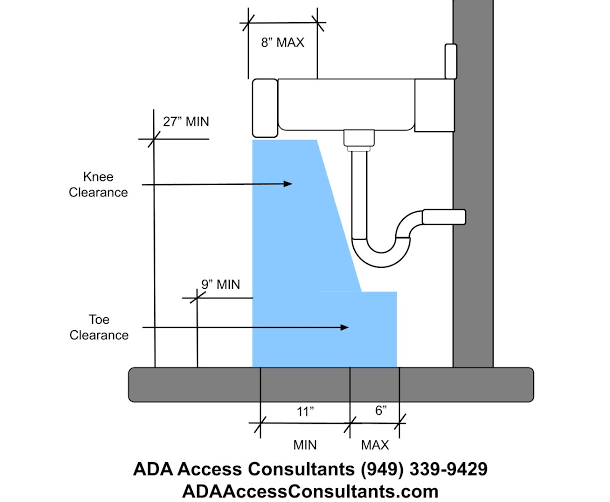
The faucet itself should not interfere with the accessible approach to the sink. Under-sink clearance is particularly important for wheelchair users who need to position themselves close to the basin.
Supply lines and other plumbing components should be arranged so they do not unnecessarily reduce required knee or toe clearance.
Where exposed pipes are present, appropriate insulation or protection should be provided in accordance with applicable accessibility requirements.
Choosing Faucets for Different Facilities
Faucet requirements can vary depending on where the sink is installed.
Hotels
Hotel bathrooms often benefit from intuitive faucet controls that are easy for guests to understand. Durability and simple maintenance are also important because fixtures may be used frequently.
Offices
Office bathrooms may require reliable faucets capable of handling daily employee and visitor use. Easy-to-clean designs can also simplify routine maintenance.
Public Buildings
Public facilities often experience high traffic. Sensor-operated or durable lever faucets may be considered depending on the facility’s requirements, maintenance capabilities, and design objectives.
Healthcare Facilities
Healthcare environments can have specialized hygiene and cleaning requirements. Faucet selection should therefore be coordinated with the facility’s infection-control procedures and applicable standards.
Common Faucet Selection Mistakes
Several seemingly minor choices can reduce the usability of an accessible sink.
One common issue is selecting a faucet based only on appearance. A stylish control may not be practical if it requires excessive force or precise finger movements.
Another mistake is overlooking reach and positioning. Even an easy-to-operate faucet can become difficult to use when installed too far from the user.
Other issues include:
- Controls that require tight grasping or twisting
- Poor sensor positioning
- Excessive operating force
- Inadequate clearance around the faucet
- Incompatible faucet and sink dimensions
- Difficult-to-maintain mechanisms
Reviewing these details before installation can help avoid costly changes later.
Balancing Accessibility and Modern Design
Accessible faucets are available in many contemporary styles, so functional requirements do not necessarily limit design choices.
Minimalist lever faucets, streamlined sensor models, and integrated control systems can complement modern bathroom interiors. The important consideration is to verify that the chosen product meets the relevant accessibility and performance requirements.
Designers can therefore consider appearance, finish, durability, and accessibility together rather than treating them as separate decisions.
Maintenance Considerations
A faucet that is easy to operate should also be easy to maintain. Commercial facilities should have straightforward access to components that may eventually require cleaning, adjustment, or replacement.
Sensor faucets may require battery or electrical maintenance, while mechanical faucets may need cartridge or valve servicing. The expected maintenance schedule should be considered before choosing a particular system.
Regular inspection can help identify dripping, loose handles, inconsistent water flow, or sensor problems before they affect users.
Final Thoughts
Faucet selection has a direct impact on how accessible a bathroom sink is in everyday use. Handle design, operating force, sensor performance, reach, temperature control, and installation position all deserve careful consideration.
When planning ADA-compliant bathroom installations, the faucet should be evaluated together with the sink, countertop, plumbing, and surrounding clearances. A coordinated approach can create a fixture that is easier to operate while maintaining durability, safety, and a modern appearance.