

Moving mixtures of liquid and solid particles requires equipment that can withstand conditions far more demanding than ordinary water pumping. Abrasive solids can cause wear, while high slurry concentrations can affect flow, pressure, and energy requirements.
A centrifugal slurry pump is designed to address these challenges by using centrifugal force to move slurry through a piping system. Its operating principle is straightforward, but the pump’s internal design is adapted to handle abrasive and dense materials.
What Is a Centrifugal Slurry Pump?
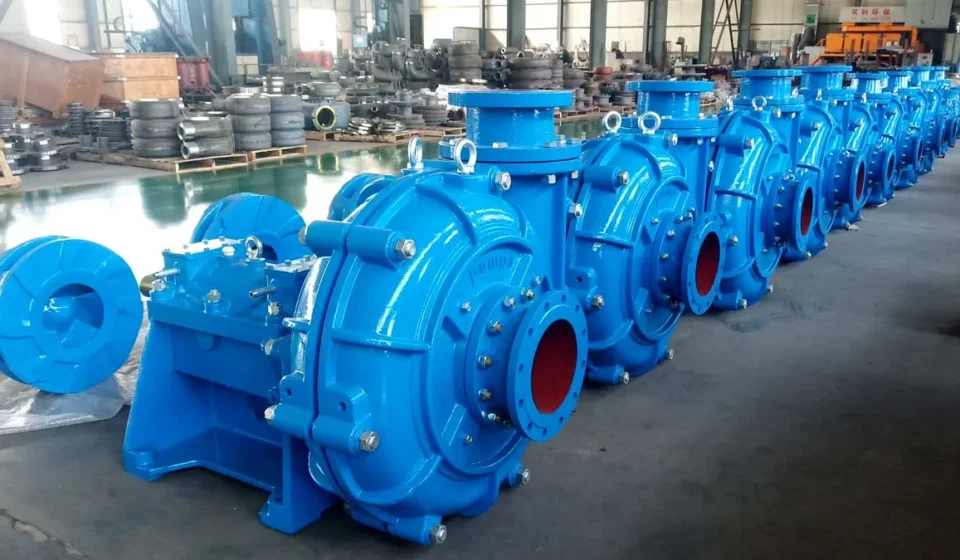
A centrifugal slurry pump is a mechanical device used to transport a mixture of liquid and suspended solid particles. It is commonly found in mining, mineral processing, dredging, construction, and other industries where solid-containing fluids need to be moved.
The pump operates using a rotating impeller. As the impeller transfers energy to the slurry, centrifugal force moves the mixture outward and generates the pressure required for discharge.
How Does a Centrifugal Slurry Pump Work?
The pumping process can be understood through several stages.
1. Slurry Enters the Pump
The slurry enters through the suction inlet and moves toward the center, or eye, of the rotating impeller. Proper suction conditions are important to ensure that the pump receives a consistent supply of slurry.
2. The Impeller Rotates
A motor or other drive system rotates the impeller through a connected shaft. The impeller’s vanes interact with the slurry and transfer mechanical energy to the mixture.
This energy increases the velocity of the slurry as it moves from the center of the impeller toward its outer diameter.
3. Centrifugal Force Moves the Slurry Outward
As the impeller rotates, centrifugal force pushes the slurry outward. The velocity generated by the impeller gives the mixture the energy needed to continue moving through the pump.
The impeller design affects how efficiently energy is transferred and how the pump handles solid particles.
4. The Casing Converts Velocity Into Pressure
After leaving the impeller, the slurry enters the pump casing. The casing is designed to guide the flow toward the discharge outlet while converting part of the slurry’s velocity into pressure.
This pressure enables the slurry to overcome resistance in the downstream piping system.
5. Slurry Leaves Through the Discharge
The pressurized slurry exits through the discharge outlet and enters the connected pipeline. The process continues as long as the pump receives slurry and the impeller remains in operation.
Main Components Involved in Pumping
Several components work together to make the pumping process possible.
Impeller
The impeller is the primary rotating component. It transfers energy to the slurry and determines much of the pump’s hydraulic performance.
Its design must also provide sufficient passage space for the solid particles being transported.
Pump Casing
The casing surrounds the impeller and directs the slurry toward the discharge. It is exposed to abrasive material, so its construction must be appropriate for the expected slurry conditions.
Shaft
The shaft transfers rotational power from the drive system to the impeller. Adequate shaft strength and alignment are important for stable operation.
Wear Components
Internal surfaces exposed to abrasive slurry may use liners or other replaceable wear components. These parts help protect critical pump structures from erosion.
Bearings and Sealing Components
Bearings support the rotating shaft, while sealing components help control leakage around the shaft. Both systems contribute to reliable and stable pump operation.
Why Slurry Pumping Requires Special Design
The basic centrifugal pumping principle is similar to that used for clean liquids, but slurry creates additional challenges. Solid particles can repeatedly impact and rub against internal surfaces, causing erosion.
Dense slurry can also require greater power to achieve the desired flow and pressure. For these reasons, slurry pumps generally use more robust components and materials suited to abrasive service.
Factors That Affect Pump Performance
The working principle remains consistent, but actual performance depends on several operating conditions.
Important factors include:
- Slurry density
- Solids concentration
- Particle size
- Particle hardness and shape
- Flow rate
- Required discharge pressure
- Pump speed
- Pipeline length and resistance
- Suction conditions
- Slurry temperature and chemical properties
A change in any of these factors can influence pump efficiency, wear rate, or operating stability.
How Abrasive Materials Affect Operation
Abrasive particles gradually wear components that come into contact with the slurry. The severity of this wear depends on particle characteristics and operating velocity.
Hard, sharp, or large particles can be particularly aggressive. Operating a pump outside its intended range may also increase wear and energy consumption.
Using suitable wear-resistant materials and replacing worn components when necessary can help maintain performance.
Importance of Correct Pump Selection
Understanding the working principle is only the first step in choosing a slurry pump. The pump must also be matched to the application’s hydraulic and material-handling requirements.
Flow rate, total head, slurry density, particle size, solids concentration, and abrasiveness should all be evaluated before selecting equipment. Proper sizing helps ensure that the pump operates within a suitable performance range.
Maintenance and Operating Considerations
Routine inspection can help identify problems before they cause major failures. Operators should pay attention to changes in vibration, noise, pressure, flow, temperature, and leakage.
Wear parts should be inspected regularly, especially in applications involving highly abrasive solids. Maintaining appropriate operating conditions can also help extend component life.
Conclusion
The working principle of a centrifugal slurry pump is based on transferring mechanical energy from a rotating impeller to a liquid-solid mixture. The impeller increases slurry velocity, while the casing helps convert that velocity into pressure for pipeline transportation.
What distinguishes slurry pumping from conventional liquid pumping is the equipment’s ability to operate under abrasive and high-solids conditions. Proper pump selection, suitable materials, controlled operating conditions, and regular maintenance are essential for achieving reliable performance.