
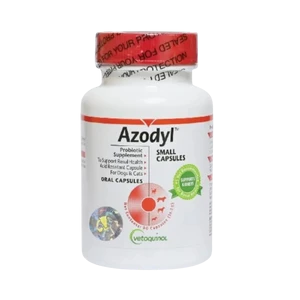

Azodyl is one of the better-known names in pet kidney support, and it often comes up when a dog or cat is diagnosed with reduced kidney function. Owners then search for it online and quickly find several bottle sizes, capsule sizes and listings that do not all look alike.
Before buying, it helps to understand what Azodyl is, how it differs from medicines, and why the small-capsule presentation needs particular care with storage and handling. This guide walks through the details that matter.
What Azodyl is
Azodyl is a renal-support supplement associated with Vetoquinol. Rather than a drug, it is a probiotic-style formulation. Its listed key ingredient is a Kibow Biotics formulation, which includes live bacterial strains such as Streptococcus thermophilus, Lactobacillus acidophilus and Bifidobacterium longum. Manufacturer information in some markets also lists psyllium husk. The stated minimum activity for the small capsule is 15 billion CFU per capsule.
Because it is a supplement, Azodyl sits in a different category from prescription kidney medicines. It is not a cure for kidney disease, and it does not replace a renal diet, fluid therapy or any medicine your vet has prescribed. Many vets view it as an optional addition to a broader plan, decided case by case.
Why the small capsule matters
Azodyl has been made in more than one capsule size, and the small capsule is a distinct presentation. Manufacturer information describes a 90-count bottle for the small capsules, but pack options can vary by market. That is why it is best to treat each bottle as its own product and read the label rather than assuming every Azodyl bottle is identical.
When you look at a listing such as Azodyl Small Capsules on Vetra Recare, pack options and price are handled by enquiry. Confirm the exact bottle size, capsule size and availability before you order, and check that the bottle you receive matches.
Storage: keep it cold
One of the most important details with Azodyl is storage. Because the capsules contain live bacteria, manufacturer information advises keeping them refrigerated at 2 to 8°C. Warm storage can reduce the number of live organisms, which may affect the product.
A few practical habits help:
- Put the bottle in the fridge as soon as it arrives.
- Keep it away from the freezer section, since freezing is not the same as refrigeration.
- Note the expiry date when you open a new bottle.
- If a delivery has been left in a hot place for a long time, ask the seller and your vet before using it.
How capsules are usually given
Manufacturer guidance says the capsules should be given whole, without opening or crushing them, and on an empty stomach. This keeps the contents protected as they pass through the stomach. The number of capsules and how often to give them should come from the label and your vet, based on your pet’s size and condition.
Giving whole capsules to cats can be a challenge. If your cat refuses or spits them out, ask your vet for tips rather than opening the capsule yourself. Pill pockets, pill givers and a quick follow-up of water or a treat are common options, but check with your clinic first.
Fitting Azodyl into a wider kidney plan
Kidney care for pets usually involves several parts working together. A typical plan might include:
- A therapeutic or renal diet, if your vet recommends it.
- Good hydration, sometimes with wet food or extra water stations.
- Regular blood and urine tests.
- Prescription medicines where needed.
- Optional supplements, such as Azodyl, when your vet agrees.
If you are comparing supplements, it can help to browse a range of kidney and urinary care products to see how different supplements and medicines are presented. Remember that sharing a category does not make products equivalent. A probiotic supplement, an amino-acid supplement and a prescription tablet all work differently and serve different purposes.
Introduce one change at a time
If you add Azodyl at the same time as a new food or medicine, it becomes hard to tell what caused any improvement or upset. Starting one new product at a time and noting the date gives you and your vet clearer information.
Signs to report to your vet
While using any new supplement, keep an eye on:
- Appetite and willingness to eat.
- Vomiting or changes in stool.
- Water intake and urination.
- Energy and weight.
Report any significant change promptly. Kidney conditions can shift over time, and your vet may want to adjust the whole plan, not just the supplement.
Questions to ask before buying
- Is Azodyl suitable for my pet’s current stage?
- Which capsule size and bottle should I use?
- How many capsules, and how often?
- Can it be given alongside my pet’s current medicines and diet?
- When should we recheck bloodwork?
Frequently asked questions
Is Azodyl a prescription medicine?
No. Azodyl is a renal-support supplement based on live bacterial strains. It does not replace any prescribed treatment.
Does Azodyl need to be refrigerated?
Manufacturer information advises refrigeration at 2 to 8°C, because the capsules contain live bacteria. Always follow the storage instructions on your bottle.
Can I open the capsule and mix it with food?
Manufacturer guidance says to give capsules whole, without opening or crushing them. Ask your vet if your pet has trouble swallowing capsules.
Are all Azodyl bottles the same?
No. Capsule sizes and bottle counts can differ. Check the exact presentation on the label and product page before ordering.
Final thoughts
Azodyl for dogs and cats can be part of a vet-led kidney care plan, but the details matter. Choose the right capsule size, keep the bottle in the fridge, give capsules whole and introduce it on its own so you can see how your pet responds. With those steps, you and your vet can judge its place in your pet’s care with confidence.
