
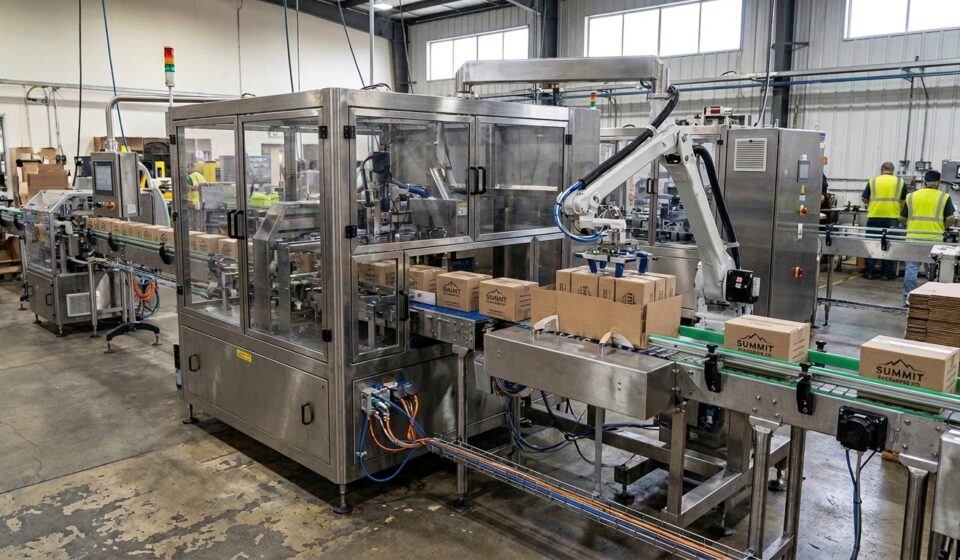

A case packing machine rarely works alone on a modern production line. Products need to arrive in the correct position, cartons need to reach the packing station at the right time, and finished cases often move directly toward sealing, palletizing, or other downstream processes.
A wrap around case packer typically connects with several types of line equipment to create a continuous packaging process. The exact setup depends on the product, case format, production speed, available floor space, and the level of automation required.
Product Conveyors
Product conveyors often serve as the first major connection to a case packing system. They transport products from upstream processing or filling equipment toward the packing station.
The conveyor needs to maintain a steady product flow without creating excessive gaps or congestion. Proper spacing also helps the case packer group the correct number of products for each case.
Depending on the product, the line may use belt conveyors, chain conveyors, roller conveyors, or specialized conveying systems.
Product Collation Equipment
Products may need to form specific rows or groups before entering the case. Collation equipment organizes individual units into the configuration required by the case design.
This stage becomes especially important when several products must enter a case in a predetermined arrangement. Accurate grouping helps the packing machine load products consistently.
Collation systems may use guides, belts, timing mechanisms, or other positioning components to create the required pack pattern.
Infeed Systems
The infeed section connects the product flow with the actual packing process. Its job involves presenting products to the machine in a controlled and repeatable manner.
A well-designed infeed reduces irregular product spacing and helps prevent interruptions at the loading point.
The infeed configuration should match product dimensions, shape, speed, and the required number of units per case.
Carton Blank Feeding Equipment
A wrap-around case packer works with flat corrugated blanks before forming them around the products. The blank supply system therefore plays an important role in continuous operation.
The machine needs a reliable supply of correctly sized blanks. Poor blank feeding can create interruptions even when the product conveyor operates normally.
Manufacturers should consider blank dimensions, board characteristics, storage arrangements, and replenishment requirements when planning this section of the line.
Glue Application Systems
Adhesive equipment forms part of the case closing process. The system applies adhesive to designated areas of the corrugated blank as the machine folds the case around the product group.
Hot-melt adhesive systems often suit high-speed packaging applications because they support rapid bonding. The specific adhesive and application method should match the board material and production conditions.
Consistent adhesive placement helps maintain secure case construction throughout the production run.
Case Compression Equipment
After folding and adhesive application, the finished case may pass through a compression section. This equipment holds the case in position while the adhesive develops sufficient bond strength.
Compression time and pressure depend on the adhesive, board construction, case design, and line speed.
Proper compression helps prevent panels from opening or shifting before the case moves to the next stage.
Case Conveyors
Finished cases commonly travel on conveyors after leaving the packing machine. These conveyors move packages toward inspection, sealing, labeling, palletizing, or other downstream operations.
The conveyor design should account for case dimensions and weight. Accumulation capability may also help maintain production flow when downstream equipment temporarily operates at a different speed.
Checkweighing Equipment
Some packaging lines include checkweighers after case packing. These systems verify the weight of finished cases and help identify potential packing errors.
An unexpected weight difference may indicate a missing product, an incorrect product count, or another packaging issue.
Checkweighing can provide an additional quality-control step without requiring manual inspection of every case.
Vision Inspection Systems
Vision systems can inspect cases and products using cameras and image-processing technology. Their role depends on the quality requirements of the application.
A vision system may check product presence, case appearance, label position, package orientation, or other defined characteristics.
Integrating inspection equipment with the packaging line can help identify defects before cases reach the shipping area.
Case Labeling Equipment
Some applications require labels on the outside of the finished case. A case labeler can apply identification information automatically as cases move along the conveyor.
Labels may contain information such as product details, batch information, barcodes, or shipping data.
The labeler’s position and speed should match the case conveyor so that each package receives the label accurately.
Case Sealing Equipment
Not every wrap-around case requires the same closure arrangement. Depending on the package design, additional sealing equipment may form part of the downstream system.
The sealing process needs to maintain the integrity of the finished package while supporting the required production rate.
Manufacturers should define the final case format before selecting complementary sealing equipment.
Palletizing Systems
High-volume packaging lines often send finished cases directly to an automated palletizer. The palletizer organizes cases into predetermined patterns and builds stable pallet loads.
Automated palletizing can reduce manual handling after the case packing stage. It also helps maintain consistent stacking patterns across production runs.
The palletizer should accommodate the case dimensions, weight, pallet size, and required stacking configuration.
Stretch Wrapping Equipment
A stretch wrapper may follow palletizing equipment to secure the completed pallet load. The system applies stretch film around the stacked cases to help stabilize them during storage and transportation.
The need for stretch wrapping depends on the distribution requirements and pallet configuration.
When integrated properly, the wrapper completes another step in the automated packaging sequence.
Controls and Line Integration
Mechanical equipment represents only part of a connected packaging line. Control systems allow individual machines to communicate and coordinate their operation.
Sensors, programmable logic controllers, variable-speed drives, and safety systems help synchronize product movement and machine cycles.
A well-integrated line can automatically respond to conditions such as product accumulation, low blank supply, downstream stoppages, or case-packing faults.
What Should You Consider Before Connecting Equipment?
Adding equipment around a case packer requires careful planning. Manufacturers should evaluate the entire production flow instead of selecting individual machines independently.
Important considerations include:
- Product dimensions and weight
- Required cases per minute
- Case size and configuration
- Conveyor height and direction
- Available floor space
- Upstream production speed
- Downstream packaging requirements
- Control-system compatibility
- Operator access
- Safety requirements
These factors help determine whether the equipment can operate as one coordinated system.
Building a Balanced Packaging Line
Line speed should remain balanced across the different stages. A fast case packer cannot deliver its full output when the product infeed cannot supply enough units.
The same principle applies downstream. A palletizer or labeling system with lower capacity may create accumulation and eventually force the packing machine to stop.
Engineers should therefore consider throughput across the complete line rather than focusing on the speed of one machine.
How Techflow Pack Fits Into Line Planning
Techflow Pack provides case packing solutions for manufacturers looking to automate product packaging and case formation. Machine selection should take into account the products, corrugated blanks, case dimensions, production targets, and surrounding equipment.
Techflow Pack can also serve as a reference point when evaluating how a case packing machine fits within a larger automated packaging system. Proper planning helps manufacturers create a line that moves products smoothly from the primary production process through final pallet preparation.
Final Thoughts
A wrap-around case packing station can connect with much more than a product conveyor. Product collators, blank feeding systems, adhesive equipment, compression sections, inspection systems, case conveyors, labeling machines, palletizers, and stretch wrappers may all form part of a complete packaging line.
The right combination depends on the application’s products, case format, throughput requirements, and automation goals. Planning the equipment as one integrated system helps reduce bottlenecks, improve consistency, and create a more efficient packaging operation.