
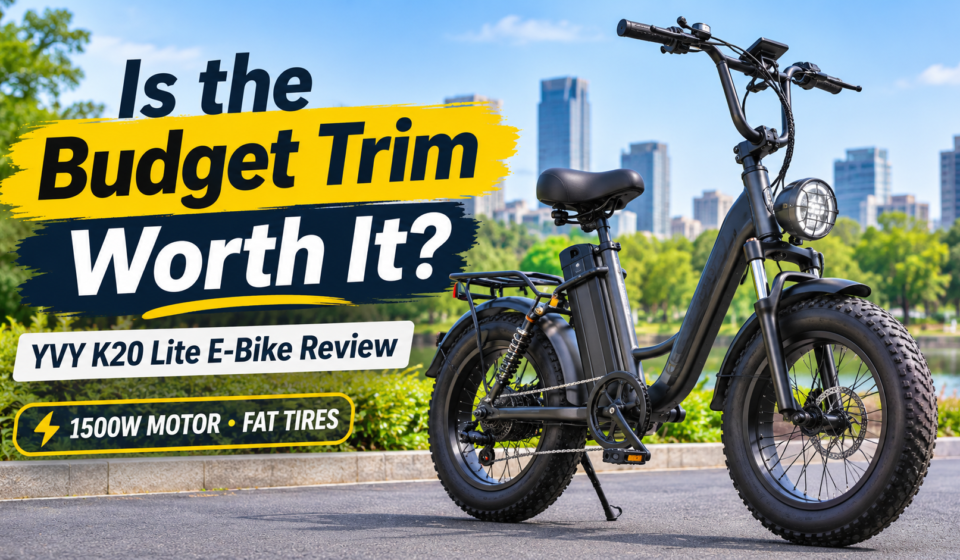

Every e-bike lineup has a version built to answer one question: how much can a brand cut from the price without the bike feeling noticeably worse to actually ride? The YVY K20 Lite is that answer for the K20 family. It keeps the same wheel size and general silhouette as the standard K20 but trims the battery capacity and swaps hydraulic brakes for mechanical ones, landing at a meaningfully lower price point in YVY’s current lineup.
What Changes, Specifically
Per the current listing, the K20 Lite runs a 1,500W motor and a removable 48V 15.6Ah battery, down from the standard K20’s 20Ah pack. Tires stay at 20-by-4.0 inches with front-and-rear suspension, and gearing is the same Shimano 7-speed setup. The clearest difference on paper is the brakes: mechanical disc brakes here instead of the hydraulic brakes on the standard K20, which is the most common place budget trims cut corners across the fat tire e-bike category generally, not just on this particular bike.
Rated range on the listing is up to 30 miles in pure electric mode and up to 50 miles in pedal-assist mode, noticeably lower than the standard K20’s posted 50 and 75 mile figures, which tracks with the smaller battery pack. As with any manufacturer-stated range, actual mileage depends heavily on rider weight, terrain, wind, and how much the motor is doing versus the rider’s own pedaling, so these numbers are best read as an upper bound rather than a guarantee for any specific ride.
Mechanical vs. Hydraulic Brakes, Honestly
It’s worth being plain about what the brake downgrade actually means day to day, since “mechanical disc brakes” can sound like a bigger compromise than it usually is for moderate riding. Mechanical brakes require more hand force and slightly more maintenance attention, since cable tension needs occasional adjustment as pads wear, whereas hydraulic systems self-adjust. For flat, low-speed commuting, the practical difference is often small. For a rider who regularly descends hills while loaded, or rides in wet conditions often, hydraulic brakes earn their keep more clearly, and that’s a legitimate reason to look at the standard K20 instead.
Who Should Actually Buy the Lite
The Lite trim makes the most sense for a first-time e-bike buyer who isn’t certain yet how much they’ll actually use a fat tire bike, or for a rider whose daily distance comfortably fits inside a 30-to-50-mile range window without pushing it. Buying the more expensive K20 or K20 Pro on the assumption that “more capacity is always better” can mean paying for range and braking performance that never actually gets used, while the Lite’s lower weight (a smaller battery weighs less) can make it marginally easier to maneuver for someone less confident handling a heavier bike.
Where the Lite tends not to be the right call is for anyone planning regular hill climbing, longer weekend rides near the edge of its rated range, or frequent wet-weather riding where hydraulic braking consistency matters more. YVY K20 is the natural step up in that case, and the dual-battery K20 Pro sits further up the range still for riders who know they’ll want meaningfully more distance per charge.
Thinking About Total Cost, Not Just Sticker Price
A lower purchase price is the headline appeal of a Lite trim, but it’s worth running the math on what a smaller battery actually costs over time versus what it saves upfront. A rider who ends up charging more frequently because 15.6Ah doesn’t comfortably cover their regular route isn’t necessarily saving money in any meaningful sense, just shifting the cost from the purchase to daily inconvenience. The right way to evaluate the savings is against an honest estimate of typical riding distance, not against the sticker price difference alone.
A Practical Way to Decide
A reasonable way to settle the question is to map out an actual week of planned riding, total expected mileage, typical terrain, and how often wet-weather riding is likely, and compare that against the Lite’s 30/50-mile range figures with some margin for real-world variance built in. If the Lite’s numbers cover a typical week comfortably, the lower price is close to free value. If a typical week pushes close to or past the upper figure regularly, the math starts favoring the standard K20 instead, where the extra battery capacity and brake upgrade are doing real work rather than sitting unused.
YVY’s own review of the K20 Lite goes further into this same budget-versus-capability tradeoff, with more detail on which riders the brand itself positions this trim toward, and is worth reading alongside the spec sheet rather than relying on the spec sheet in isolation.
Where the Lite Earns Its Place
The K20 Lite isn’t a lesser version of the K20 so much as a different answer to a different question: how to get into a fat tire e-bike without paying for capacity a given rider may not need. For the right use case, that’s a genuinely sound trade. For a rider whose actual riding habits push past what a 15.6Ah battery and mechanical brakes comfortably support, the savings stop looking like savings fairly quickly, which is exactly why matching the bike to real riding habits matters more here than chasing the lowest price in the lineup.