
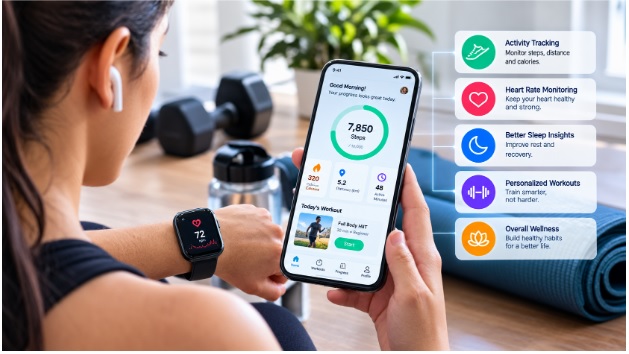

Tasha had started the same fitness plan every January for six years running, and by February it was always gone. A sixty-minute workout plan built for a version of her life she didn’t actually have, three missed sessions in a row, then quiet abandonment nobody noticed because nobody was watching. This year was different for one reason that had nothing to do with willpower: the app she downloaded didn’t ask her to commit to an hour. It asked her to do four minutes, log it, and come back tomorrow.
That shift, from ambitious plans that collapse under real life to small actions that actually survive contact with a Tuesday, is exactly the problem a fitness app development company is now building around, because the research on why people quit has gotten a lot more specific than “they lacked motivation.” Most people don’t abandon a fitness routine because they don’t care about their health. They quit because a generic plan ignored their actual schedule, nobody noticed when they stopped showing up, and one missed session turned into permission to quit entirely. The apps solving this problem well are doing it through actual behavior science rather than a nicer-looking calendar.
Willpower Was Never the Real Problem
For years the fitness industry treated consistency as a character trait, something people either had or didn’t. The behavior science underneath habit-focused apps rejects that framing entirely. A habit-focused tool removes the daily decision of what to do, surfaces a clear cue to start, and rewards small wins immediately rather than promising a distant reward weeks away. The real reasons people fall off a routine tend to be structural rather than personal: a plan built for someone else’s life, no accountability loop to notice an absence, all-or-nothing thinking where missing two sessions feels like failure instead of a normal blip, and no way for the plan to adapt when travel, an injury, or a rough week derails the original schedule.
Small Actions Outperform Big Plans
The apps getting real long-term adherence have largely abandoned the sixty-minute ideal session in favor of micro-habits that take under five minutes. The logic is straightforward: a four-minute movement break has almost no barrier to starting, while an hour-long workout requires clearing a mental hurdle every single day before it even begins. Several popular platforms now build entire onboarding flows around breaking a goal down into pieces small enough that skipping feels harder than doing, framing consistent tiny improvement as the actual mechanism behind meaningful change over a year rather than a single dramatic effort. Habit stacking reinforces the same idea, attaching a new habit to something already automatic, doing ten squats while the coffee brews, stretching during the first ad break, so the new behavior borrows momentum from a routine that’s already unconscious.
Streaks Work Because of a Specific Psychological Trick
A visible streak counter sounds almost too simple to matter, but the mechanism behind it is well established: people are more motivated to avoid breaking a chain of consecutive days than they are to chase a distant reward. The apps designing this well have started adding a grace day into the streak logic, letting one missed day pass without resetting the entire count to zero, because the older, harsher version of streak tracking taught a specific unhelpful lesson: one bad day means starting over, so quitting after a slip is basically the same as continuing. A habit strength meter, showing how deeply wired a specific behavior is becoming rather than just counting consecutive days, gives a more honest signal of actual progress than a streak number that can vanish overnight.
The Science Behind How Long a Habit Actually Takes
The widely cited figure behind habit-building programs traces back to research out of University College London, and while the specific number gets oversimplified in marketing copy, the underlying finding holds up: forming an automatic habit takes weeks of repetition, not days, and the exact timeline varies considerably by person and by habit. Apps building genuinely around this research tend to set expectations accordingly, structuring a program as a gradual build over roughly two months rather than promising a transformed routine after a single motivated week. Temptation bundling, pairing a habit with something the person already wants, listening to a favorite podcast only during a workout, for instance, shows up frequently in these programs specifically because it borrows an existing source of enjoyment rather than asking discipline to do all the work alone.
Other People Watching Changes Behavior More Than People Expect
Social accountability turns out to matter more than most fitness apps initially assumed. One study followed hundreds of runners across several running clubs on a popular fitness-tracking platform over nearly a year and found a clear pattern: runners who received more encouragement and positive feedback from others gradually increased how often they ran, and that behavior spread through a social network the same way a habit spreads between people who see each other regularly. That finding has pushed more fitness apps to build genuine community features directly into the core experience rather than treating social interaction as a bolt-on, shared challenges, visible encouragement from other users, local groups organized around a shared activity, because the data suggests these features do real behavioral work rather than just adding a social layer for its own sake.
Timing and Friction Matter More Than Motivation Itself
A well-timed reminder at the moment someone is actually available to act beats a generic daily notification sent at the same hour regardless of context. The stronger habit apps now support customizable reminder windows rather than a single fixed alarm, quiet hours so a notification never lands at the wrong moment, and reminders that resurface later if snoozed rather than disappearing and being forgotten. This attention to timing reflects a broader shift in how these apps think about behavior: reducing the friction and decision fatigue standing between a person and the action matters more than trying to generate more motivation through a louder notification or a more enthusiastic message.
What Actually Drives the Cost of Building One of These
A basic habit tracker with reminders and simple streak counting sits at the modest end of what a build like this costs, while a platform combining adaptive programming, social accountability features, and integration with wearable data runs considerably higher. Fitness Application Development Cost scales mostly with how much personalization and behavioral logic sits underneath the interface, since building a system that actually adapts a plan based on missed sessions, real schedule changes, or a person’s specific habit strength is a meaningfully harder engineering problem than a static workout calendar with a checkbox. Privacy-focused, on-device data handling adds its own cost layer too, but it’s increasingly become the baseline users expect rather than a premium feature worth charging extra for.
Where Gamification Can Quietly Backfire
None of this comes without a real downside worth naming plainly. Streaks and social features designed to build consistency can just as easily produce anxiety in someone who starts treating an unbroken chain as more important than the actual underlying goal, working out even while injured just to avoid losing a streak, or feeling genuine distress over a single missed day that was never actually a meaningful setback. The apps handling this responsibly tend to frame a missed day as normal rather than catastrophic, build in the grace-day mechanics already mentioned, and avoid language that turns a wellness tool into another source of daily pressure. A habit-building app that quietly makes someone more anxious about their body has failed at its actual job regardless of how impressive its streak numbers look.
Wearable Data Is Starting to Close the Loop
Habit-tracking apps used to rely entirely on a person manually logging what they did, which introduces its own friction and its own honesty problem, since a person having a bad week is exactly the person least likely to open an app and log a missed workout. Integration with a phone’s step count or a connected wearable closes part of that gap automatically, logging real movement without requiring a manual entry every time, and giving a more honest picture of actual activity than self-reported logs ever provide. Apple Watch complications and home screen widgets keeping a habit visible without opening the app at all serve a similar purpose, reducing the number of steps between intention and action down to something closer to a glance rather than a full app launch.
Adaptation Matters More Than the Initial Plan
A program that never changes eventually breaks against the reality of an actual life, a stressful work week, an injury, travel, a shift in energy or schedule that the original plan never accounted for. The apps producing genuine long-term adherence build real adaptation into the core logic rather than treating a rigid plan as the whole product, adjusting intensity when someone reports low energy, offering a shorter alternative when a full session clearly isn’t happening that day, and treating a schedule change as a normal input to plan around rather than a reason the whole system falls apart. That flexibility matters more over a year than any single feature of the original plan, since the plan a person actually follows consistently will always outperform the theoretically ideal one they abandon after three weeks.
What Changed for Tasha
Tasha’s app never asked her to commit to an hour she didn’t reliably have. It asked for four minutes, logged what she did, and reminded her gently the next day rather than shaming her for a gap. Six Februaries of abandoned plans later, she’s still going, not because this year she found more willpower than the previous six, but because the plan finally fit the actual life she was living instead of the idealized one a January resolution always imagines. That’s the real shift running through fitness technology right now, not flashier tracking or a longer feature list, but tools finally built around how habits actually form instead of how motivated someone feels on day one.