

A refrigerator is one of the most important appliances to protect during a prolonged power outage. Without electricity, cooling eventually stops, which can put perishable food at risk. A suitable backup power system can help maintain refrigeration while also supporting other essential household devices.
This refrigerator backup power guide explains how to choose an appropriate backup system by looking at refrigerator power requirements, compressor startup demand, battery capacity, output ratings, and energy management.
Why Refrigerators Need Special Backup Planning
Refrigerators do not consume a fixed amount of electricity continuously. Their compressors cycle on and off to maintain the internal temperature.
When the compressor starts, it can temporarily require more power than it uses during normal operation. This startup demand means a backup system needs enough peak output as well as sufficient continuous output.
Simply matching a generator to the refrigerator’s normal running wattage may therefore be insufficient.
Check Your Refrigerator’s Wattage
Before selecting a portable power station or generator, check the refrigerator’s electrical specifications.
The manufacturer’s label or documentation may provide:
- Running or rated wattage
- Voltage
- Startup or surge wattage
- Electrical requirements
Use the refrigerator’s actual specifications whenever possible because power requirements can vary between models.
Understand Running and Startup Power
Two power ratings are particularly important when planning refrigerator backup.
Running power is the electricity the refrigerator normally uses while operating.
Startup power is the temporary increase that can occur when the compressor starts.
A backup system should have continuous output that can support the refrigerator’s normal demand and peak output that can accommodate its startup requirement.
Generator Capacity and Output Are Different
For battery-powered systems, capacity and output measure different things.
Capacity is measured in watt-hours (Wh) and indicates how much energy the battery stores.
Output is measured in watts (W) and indicates how much power the system can deliver at one time.
For example, the GEYOTO N300 has 256Wh of capacity, while the N1000 has 1,024Wh.
A larger battery can provide more stored energy, but the system must still have enough output to start and operate the refrigerator.
How Long Can a Portable Power Station Run a Refrigerator?
There is no universal runtime because refrigerators have different energy requirements and compressor cycles.
A basic theoretical calculation is:
Runtime = Battery capacity (Wh) ÷ Load (W)
For a refrigerator, however, this calculation is only an approximation. The compressor may not run continuously, while inverter losses, temperature, refrigerator efficiency, and other connected loads can affect actual energy consumption.
For better planning, use the refrigerator’s documented energy consumption when available.
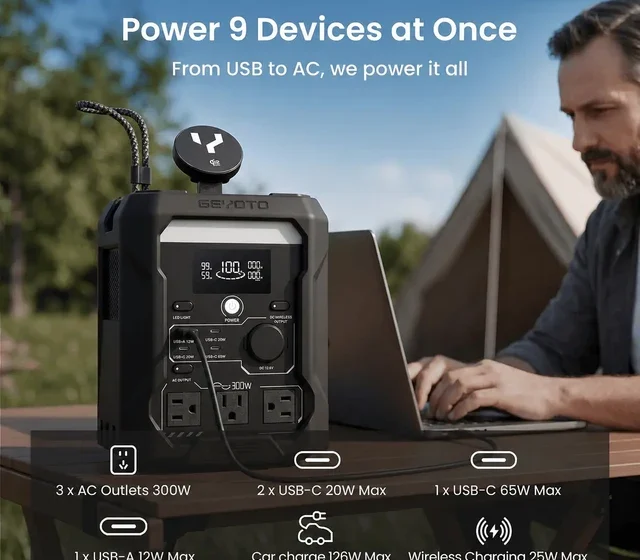
GEYOTO N300 for Short-Term Backup
The GEYOTO N300 is positioned as a compact “Grab and Go” portable power solution for camping, travel, small electronics, Wi-Fi routers, laptops, lighting, and short-term outage backup.
Its approved specifications include:
- 256Wh capacity
- 300W continuous pure sine wave output
- 500W peak output
- 550W Constant Power
- LiFePO4 battery
- 4,000-cycle battery life
- About 1.5-hour full recharge
- 9 output outlets
- 25W wireless charging
- UPS switching of less than 10ms
Whether the N300 can operate a refrigerator depends on the refrigerator’s actual running and startup requirements.
GEYOTO N1000 for Higher-Capacity Home Backup
The GEYOTO N1000 is positioned as an “All-in-One: One Station. Fully Loaded.” solution for higher-capacity portable power needs.
Its approved specifications include:
- 1,024Wh capacity
- 1,800W continuous pure sine wave output
- 3,000W peak output
- 2,400W Constant Power
- LiFePO4 battery
- 4,000-cycle battery life
- 0–80% recharge in 43 minutes
- 100% recharge in 68 minutes
- 18 total ports and interfaces, including 13 output ports
- Qi2.2 25W wireless charging
- UPS switching of less than 10ms
- XT60 vehicle-support output rated at 12.6V/30A, up to 378W
The N1000 is designed for home emergencies and applications that can include compatible refrigerators, CPAP machines, fans, Wi-Fi equipment, camping, RV trips, and vehicle-support scenarios.
Why Peak Output Matters for a Refrigerator
The refrigerator compressor can create a temporary startup load. This is why peak output deserves attention when comparing backup systems.
The N300 provides 500W peak output, while the N1000 provides 3,000W peak output.
These figures should be compared directly with the refrigerator’s documented startup requirements. Do not assume that a particular refrigerator will work simply because its running wattage appears low.
Understanding Constant Power Mode
Constant Power mode can provide additional flexibility for compatible equipment.
The N300 provides 550W Constant Power, while the N1000 provides 2,400W Constant Power.
Constant Power does not increase battery capacity. Operating a higher-power load can use stored energy more quickly, and connected equipment must remain within the applicable operating conditions.
Pure Sine Wave Output
Both the N300 and N1000 provide pure sine wave output.
This type of AC output is designed to provide a waveform similar to utility electricity and can be relevant for appliances containing motors and compressors.
However, users should still verify the refrigerator manufacturer’s electrical requirements before connecting it to a portable power station.
How to Keep Food Cold During an Outage
A suitable backup system is only part of refrigerator outage planning. How you use the appliance can also affect how long stored energy lasts.
Keep the refrigerator and freezer doors closed as much as possible. Each unnecessary opening allows cold air to escape and can increase the cooling workload.
If you are using a battery power station, prioritize the refrigerator over optional appliances when available energy becomes limited.
Avoid Unnecessary Loads
Other household devices can share a portable power station if the combined load remains within its supported output.
Essential loads may include:
- Refrigerator
- Wi-Fi router
- Essential lighting
- Phone chargers
- Laptop
- Compatible fan
Avoid connecting unnecessary high-power appliances during a prolonged outage. Reducing the total load can help preserve stored battery energy for refrigeration and other priorities.
Recharge Speed During Repeated Outages
Recharge speed can be important when electricity returns temporarily or when outages happen repeatedly.
The N300 can fully recharge in about 1.5 hours.
The N1000 reaches 0–80% in 43 minutes and 100% in 68 minutes.
A faster recharge can help restore the available energy reserve sooner after the backup system has been used.
UPS Functionality
Both the N300 and N1000 have a specified UPS switching time of less than 10 milliseconds.
UPS functionality can help reduce interruptions for compatible equipment when utility power fails. Before relying on UPS operation, check the requirements and compatibility of the connected device.
Safety and Preparation
Prepare the backup system before an outage rather than waiting until the refrigerator loses power.
Keep the power station charged according to the manufacturer’s recommendations and store the required cables where they are easy to find.
For any generator or portable power station, follow the manufacturer’s operating instructions and do not exceed rated output limits.
Fuel-powered generators require additional precautions because they produce exhaust gases. They must be operated outdoors in an appropriate location and never inside a home, garage, basement, or other enclosed space.
Refrigerator Backup Checklist
Before an outage, confirm:
- Refrigerator running wattage.
- Compressor startup or surge requirement.
- Generator continuous output.
- Generator peak output.
- Battery capacity in Wh.
- Expected outage duration.
- Other devices that will share the system.
- Suitable ports and cables.
- Recharge time.
- Manufacturer safety and compatibility requirements.
Final Thoughts
Keeping food cold during a power outage requires more than choosing a generator with a large battery. The system needs sufficient continuous output for normal refrigerator operation, enough peak output for compressor startup, and adequate stored energy for the expected outage duration.
The GEYOTO N300 provides 256Wh, 300W continuous output, and 500W peak output for compact and short-term backup applications. The N1000 provides 1,024Wh, 1,800W continuous output, and 3,000W peak output for higher-capacity home emergency applications that can include compatible refrigerators.
The most reliable approach is to check your refrigerator’s actual electrical specifications first, then select a backup system whose output and capacity match those requirements. Proper energy management and preparation can further help maintain refrigeration when the grid goes down.